IPTV vs Cable TV: Which Is Better for Your Home in 2026?
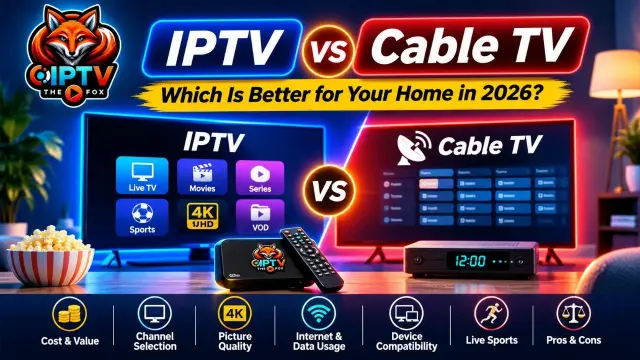
Choosing the right television service can make a big difference in how you watch your favorite entertainment. With so many viewing options available today, many households in the United States and Canada are comparing IPTV vs Cable TV to decide which solution offers better flexibility, value, and convenience.
Traditional cable television has been a popular choice for decades. It provides access to live channels through a cable network and usually comes with a set-top box or compatible television equipment. IPTV, on the other hand, delivers television content through an Internet Protocol network, allowing viewers to watch supported channels and on-demand content using compatible devices and applications.
Both options have advantages and disadvantages. Cable TV may offer a consistent viewing experience without depending on your home internet connection, while IPTV can provide more flexibility across supported devices.
In this guide, we’ll explain the differences between IPTV and cable television, compare their costs, picture quality, channel options, internet requirements, and device compatibility. We’ll also discuss what to consider before choosing a provider.
Whether you’re thinking about switching from cable or simply exploring modern television options, this comparison will help you make a more informed decision.
1. What Is IPTV?
IPTV stands for Internet Protocol Television. It is a technology that delivers television programming through Internet Protocol networks instead of relying exclusively on traditional cable or satellite television distribution.
With IPTV, video content travels through a network connection and can be played using compatible devices and applications.
Depending on the provider and service, IPTV may include several types of content:
Live TV: Television channels delivered in real time.
Video on Demand (VOD): Movies and television shows available to watch when you choose.
Time-shifted television: Supported programming that can be watched after its original broadcast.
Catch-up TV: Previously broadcast programs available for a limited period, when supported.
One of the main advantages of IPTV is device flexibility. Depending on the service and application, viewers may be able to watch on Smart TVs, streaming boxes, smartphones, tablets, and computers.
However, IPTV is not automatically better than cable. Its performance depends on the provider’s infrastructure, the quality of the video source, your internet connection, and the device you use.
It is also important to understand that IPTV is a delivery technology, not a guarantee that a particular service has permission to distribute every channel or program it advertises. Always choose a provider that is authorized to distribute its content.
2. What Is Cable TV?
Cable television is a traditional television distribution system that delivers programming to homes through a cable network.
Cable providers generally use coaxial cables, fiber-optic infrastructure, or a combination of both to distribute television signals. Customers typically subscribe to a package that includes a selection of channels.
Depending on the provider, a cable television package may include:
Local television stations.
National news channels.
Sports networks.
Entertainment channels.
Movie channels.
Premium television packages.
On-demand programming.
Many cable providers supply a set-top box that connects to your television. Some also offer apps that allow subscribers to access selected content on mobile devices or computers.
One major advantage of traditional cable television is that viewing does not normally depend on the customer’s separate home internet connection. This can be useful in areas where broadband service is unreliable.
However, cable television may involve equipment rental fees, installation charges, contracts, and additional costs for premium channels.
The exact experience depends on the cable company, location, package, and equipment.
3. IPTV vs Cable TV: Main Differences
The biggest difference between IPTV and cable television is how content reaches your screen.
IPTV uses Internet Protocol networks to deliver video, while traditional cable television uses a cable distribution infrastructure.
Here is a general comparison:
| Feature | IPTV | Cable TV |
|---|---|---|
| Delivery method | IP network | Cable infrastructure |
| Internet connection | Usually required | Usually not required |
| Equipment | Compatible device and app | Often a set-top box |
| Device flexibility | Depends on provider and app | Depends on provider |
| Live television | Available | Available |
| On-demand content | Depends on service | Depends on package |
| Data consumption | Uses network data | Usually not part of home internet data usage |
| Viewing outside home | Possible on supported services | Depends on provider’s apps |
| Monthly pricing | Varies by provider | Varies by provider |
| Performance | Depends on network and service | Depends on cable infrastructure |
Neither option is automatically the best choice for every household.
If you have reliable broadband and want to watch on several supported devices, IPTV may be attractive. If you prefer a traditional television package that does not rely on your home internet connection, cable TV may be more suitable.
4. IPTV vs Cable TV: Cost Comparison
Monthly cost is one of the most important factors when choosing a television service.
Cable television packages can include several separate charges. Depending on your provider, these may include:
Monthly television package fees.
Set-top box rental.
Installation fees.
Regional sports fees.
Broadcast or network fees.
Premium channel add-ons.
Taxes and other service charges.
A promotional price may also increase after an introductory period.
IPTV pricing varies considerably between providers. Some services offer monthly subscriptions, while others provide longer-term plans.
Before subscribing, check:
The total monthly or annual price.
Whether taxes are included.
How many devices are supported.
Whether simultaneous connections are allowed.
Whether additional equipment is required.
Whether there are cancellation or refund conditions.
Whether the provider is authorized to distribute the content.
Which Option Offers Better Value?
IPTV may offer attractive pricing and device flexibility, but the cheapest subscription is not necessarily the best option.
A very low price should not be the only reason to choose a provider. Check the available channels, video quality, customer support, application compatibility, service conditions, and content distribution rights.
Cable TV may cost more in some situations, but it can include local channels, installation support, and established customer service.
To compare fairly, calculate the full cost over 12 months rather than looking only at the advertised introductory price.
5. Channel Selection and Content Variety
Channel selection is another major consideration when comparing IPTV and cable TV.
Cable TV Channel Packages
Traditional cable companies generally organize channels into packages.
A basic package may include local stations, news, and general entertainment. Larger packages can include additional sports, movie, and specialty channels.
Customers may need to purchase premium add-ons to access certain programs or networks.
The channels available can also vary by location. A package offered in New York may not be identical to one available in Toronto or another region.
IPTV Channel Selection
IPTV services can provide different channel categories depending on the provider and its distribution agreements.
These may include:
Local and international television.
News and entertainment.
Sports programming.
Movies and television series.
Regional and language-specific content.
Some IPTV platforms also offer VOD libraries, allowing users to select content instead of following a fixed television schedule.
However, channel availability should always be verified before purchasing a subscription. A provider’s advertised channel count does not necessarily mean every channel is available in your location or at the same quality.
Which Has More Channels?
There is no universal answer.
Some IPTV services advertise extensive channel selections, while cable providers offer curated packages based on their distribution agreements and regional availability.
The best approach is to check whether the channels you actually watch are included.
A smaller package that includes your favorite programs may be more useful than a much larger package filled with channels you never watch
6. Picture Quality and Streaming Performance
Picture quality matters whether you’re watching a movie, a live sports event, or a television program.
Both IPTV and cable TV can provide high-definition content. Some services also support Full HD and 4K programming.
However, the actual quality depends on several technical factors.
IPTV Picture Quality
IPTV video is delivered through a network connection. The quality you experience may depend on:
Available internet bandwidth.
Network congestion.
Video bitrate.
Encoding and compression.
Server performance.
The capabilities of your streaming device.
The quality of the original video source.
Some IPTV applications and streaming services support adaptive bitrate streaming.
This technology can adjust video quality based on network conditions. For example, a stream may move from a higher resolution to a lower resolution when bandwidth becomes limited.
This can help maintain playback, although it may temporarily reduce picture quality.
Cable TV Picture Quality
Cable television delivers programming through its distribution network.
Because traditional cable viewing does not normally depend on your home broadband connection, it may avoid internet-related buffering caused by other devices using your Wi-Fi.
However, cable quality can still be affected by signal problems, damaged cables, provider outages, equipment issues, and the quality of the original broadcast.
Is IPTV Better for 4K?
Not necessarily.
A device that supports 4K does not automatically make every channel a 4K stream.
For 4K playback, the source content, IPTV player, streaming device, television, and network connection must all support the required format and quality.
The same principle applies to cable television: availability of 4K channels depends on the provider and package.
7. Internet Requirements and Data Usage
One of the most important differences in the IPTV vs Cable TV comparison is internet dependency.
Most IPTV services require an internet connection to deliver video content. Traditional cable television generally does not require a separate home broadband connection for ordinary television viewing.
How Much Internet Speed Do You Need for IPTV?
The required speed depends on the video resolution, bitrate, network conditions, and number of simultaneous streams.
As a general starting point, the following estimates can help with planning:
| Video Quality | Suggested Available Speed |
|---|---|
| SD | 3–5 Mbps |
| HD | 5–10 Mbps |
| Full HD | 10–15 Mbps |
| 4K | 25 Mbps or more |
These are planning estimates, not guaranteed requirements for every provider. Some streams may need more bandwidth, especially when several devices are connected at the same time.
For a smoother experience, leave additional bandwidth available for other household activities.
Does IPTV Use Internet Data?
Yes. IPTV streaming uses internet data.
The amount depends on the video bitrate and how long you watch.
For example, a high-bitrate 4K stream can consume substantially more data than a standard-definition stream.
If your internet provider applies a monthly data cap, frequent HD or 4K streaming may use a significant part of your allowance.
Cable television viewing generally does not count toward a separate home broadband data allowance because it uses the cable television distribution network.
What Happens If Your Internet Goes Down?
If your IPTV service requires an internet connection, playback will normally stop when that connection is unavailable.
Traditional cable television may continue working during a home broadband outage, provided the cable television network and equipment remain operational.
This is an important consideration for households that experience frequent internet interruptions.
8. IPTV vs Cable TV for Live Sports
Sports fans often have different priorities from other television viewers.
They may want access to live matches, multiple sports channels, replays, and coverage of major events.
Watching Sports with Cable TV
Cable television packages may include sports networks covering:
Football and soccer.
NFL.
NBA.
NHL.
MLB.
College sports.
Other regional and international competitions.
The exact selection depends on the provider, location, and subscription package.
Some sports channels require premium packages or additional fees.
Watching Sports with IPTV
IPTV services may provide sports channels through supported applications and devices.
Depending on the provider’s authorized content offering, users may be able to access selected sports programming on Smart TVs, streaming boxes, and mobile devices.
One advantage of compatible multi-device services is the possibility of watching supported content away from the main television.
Which Is Better for Live Sports?
The answer depends on your priorities.
Cable TV can provide a consistent experience without relying on home broadband.
IPTV can offer flexibility, but network latency, congestion, and stream delivery can affect how quickly live content appears.
If you watch important live events, check the provider’s actual performance and available sports rights before subscribing.
9. Device Compatibility and Flexibility
Device compatibility is one of the areas where IPTV can be particularly attractive.
Traditional cable TV is often associated with a television and provider-supplied equipment, although many cable companies now offer mobile and streaming applications.
IPTV applications may support several device categories.
Devices That May Support IPTV
Depending on the application and subscription, compatible devices can include:
Amazon Fire TV and Firestick.
Android TV devices.
Google TV devices.
Compatible Smart TVs.
iPhone and iPad.
Windows computers.
Android smartphones and tablets.
Not every IPTV player supports every device. Always check the app’s official listing and compatibility requirements.
Can You Watch IPTV on Multiple Devices?
Some IPTV subscriptions support multiple devices or simultaneous connections, while others are limited to one connection.
Before purchasing, confirm:
The number of supported devices.
Whether devices can be used simultaneously.
Whether separate subscriptions are required.
Whether your preferred applications are supported.
Cable providers may also offer multi-room equipment or mobile apps, but availability depends on the provider and package.
10. IPTV vs Cable TV: Pros and Cons
Understanding the advantages and disadvantages of both options can help you choose more confidently.
Advantages of IPTV
1. Device flexibility
Compatible IPTV services can work across several device categories, depending on the provider and application.
2. Internet-based delivery
IPTV uses IP networks, which can support live and on-demand content through compatible applications.
3. Different subscription options
Some providers offer monthly or longer-term subscription plans.
4. On-demand viewing
Some IPTV services include movies and television series that can be watched when available, rather than only at scheduled broadcast times.
5. Portable viewing
Supported services may allow customers to watch content on compatible mobile devices, subject to provider restrictions and licensing terms.
Disadvantages of IPTV
1. Internet dependency
Most IPTV services need a stable internet connection.
2. Possible buffering
Network congestion, weak Wi-Fi, packet loss, or server problems may interrupt playback.
3. Variable service quality
Not every provider offers the same streaming performance, content selection, or customer support.
4. Application compatibility
Some IPTV players are available only on specific devices or operating systems.
5. Data usage
HD and 4K streaming can consume substantial amounts of internet data.
Advantages of Cable TV
1. No separate broadband requirement
Traditional cable television generally works independently of a household’s separate internet service.
2. Established infrastructure
Cable providers often have established distribution networks and technical support.
3. Consistent viewing
Cable TV can avoid buffering caused by competition for home internet bandwidth.
4. Local programming
Cable packages may provide local channels and regional programming, depending on the area.
Disadvantages of Cable TV
1. Package restrictions
Some channels are available only in more expensive packages.
2. Additional fees
Equipment rental, installation, and premium channel charges may increase the total cost.
3. Less device flexibility
Traditional cable viewing may depend more heavily on provider equipment, although mobile apps can extend access.
4. Contracts and promotional pricing
Some providers use introductory offers or contract terms that customers should review carefully.
11. IPTV vs Cable TV vs Streaming Services
IPTV and cable television are not the only ways to watch television today.
Streaming platforms such as Netflix, Disney+, and other on-demand services have also changed how people consume entertainment.
It is useful to understand the difference between these options
IPTV
IPTV is a method of delivering television content through IP networks. Depending on the service, it may include live television, on-demand programming, or time-shifted content.
Cable TV
Cable television delivers channels through a cable distribution network. It often provides traditional channel packages and may include on-demand options.
Subscription Streaming Services
Services such as Netflix and Disney+ generally focus on on-demand movies, series, and original programming.
They do not necessarily provide the same live television experience as a traditional cable package or a live-TV IPTV service.
Quick Comparison
| Feature | IPTV | Cable TV | On-Demand Streaming |
|---|---|---|---|
| Internet required | Usually yes | Usually no | Yes |
| Live channels | Depends on service | Yes | Usually limited |
| Movies and series | Depends on service | Depends on package | Main focus |
| Device flexibility | Depends on provider | Depends on provider | Usually broad |
| Traditional channel packages | Sometimes | Yes | Usually no |
The right choice depends on whether you prefer live television, on-demand entertainment, or a combination of both.
12. Is IPTV Better Than Cable TV?
There is no single answer because different households have different viewing habits, budgets, and internet conditions.
IPTV may be a better fit if:
You have a reliable broadband connection.
You prefer watching on supported devices beyond one television.
You want access to live and on-demand content through a compatible service.
You prefer comparing different subscription plans.
You want a flexible way to access television programming.
Cable TV may be a better fit if:
Your internet connection is unreliable.
You prefer traditional television equipment.
You want a package that includes specific local channels.
You do not want television viewing to depend on home broadband.
Your cable provider offers a package that meets your needs at a reasonable total cost.
Before deciding, compare the actual channels, service conditions, total price, customer support, and cancellation policy.
Most importantly, confirm that the provider has the necessary rights to distribute the programming it offers.
13. Why Explore IPTV THE FOX?
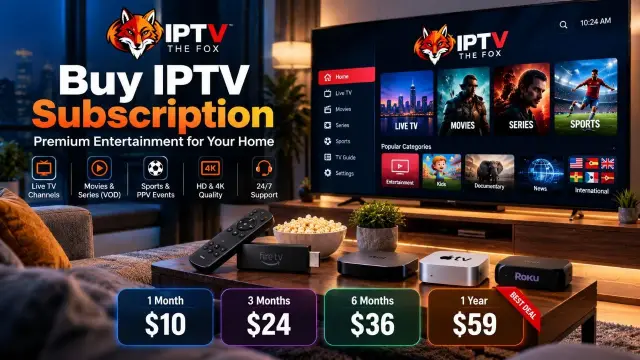
If you’re considering an internet-based television service, IPTV THE FOX is a brand you can explore when comparing compatible IPTV subscription options.
IPTV THE FOX presents a selection of live television, sports, movies, and series through supported devices and applications.
Depending on the available subscription and content rights, the service offering may include:
Live television programming.
Sports and selected PPV events.
Movies and television series.
HD, Full HD, and 4K streams where available.
Compatibility with supported streaming devices and IPTV applications.
Assistance with setup and connection questions.
A Flexible Viewing Experience
The goal of a modern television service is to make it convenient to access content on the devices you already use.
Before choosing a subscription, check whether your device and preferred IPTV player are supported.
You should also confirm the available channels, supported connection method, number of connections, pricing, and service conditions.
Getting Started with IPTV THE FOX
If you want to learn more about IPTV THE FOX, visit the official website:
Explore the available subscription information and contact the support team with questions about compatible devices, supported applications, and content availability.
You can also ask about trial availability and the applicable terms before making a purchase.
Choose a service based on verified content rights, transparent pricing, and the viewing experience that suits your household.
14. Frequently Asked Questions
1. What Is the Main Difference Between IPTV and Cable TV?
IPTV delivers television content through Internet Protocol networks, while traditional cable television distributes programming through a cable network. IPTV generally requires an internet connection, whereas cable television usually operates independently of separate home broadband service.
2. Is IPTV Cheaper Than Cable TV?
IPTV may offer lower-priced subscription options in some cases, but pricing varies widely. Compare the complete cost, including equipment, additional connections, taxes, and any optional fees, before deciding.
3. Does IPTV Need High-Speed Internet?
IPTV needs a suitable internet connection. The required speed depends on the stream quality, bitrate, number of simultaneous streams, and network conditions. HD and 4K viewing generally require more bandwidth than standard-definition video.
4. Can IPTV Replace Cable TV?
IPTV may replace cable television for households that can access the channels and programming they need through a compatible, authorized IPTV service. Check local channels, sports rights, and other essential content before cancelling cable.
5. Does Cable TV Work Without Internet?
Traditional cable television generally does not require a separate home broadband connection. However, the cable network and provider equipment must still be operational.
6. Does IPTV Buffer More Than Cable TV?
IPTV can experience buffering when the internet connection is unstable, the network is congested, or the provider has technical issues. Traditional cable television does not normally experience buffering caused by home broadband congestion, although cable signal problems can still occur.
7. Can I Watch IPTV on a Smart TV?
Many Smart TVs support IPTV player applications, but compatibility depends on the television operating system, app availability, and provider requirements. Check the official app store on your television.
8. Can I Watch IPTV on Firestick?
Some IPTV player applications are available for compatible Fire TV devices. You must install a supported player and provide subscription details from an authorized IPTV provider.
9. Is IPTV Legal in the United States and Canada?
IPTV technology itself is legal. However, the legality of a particular service depends on whether it has the necessary rights and authorization to distribute the content it offers. Consumers should choose providers that respect copyright and broadcasting laws
10. Can IPTV Provide 4K Channels?
Some IPTV services offer 4K content, but availability depends on the provider’s content sources, distribution rights, application, device, and internet connection. A 4K television alone does not guarantee that every channel will be available in 4K.
11. Does IPTV Use My Internet Data?
Yes. IPTV streaming consumes internet data. Higher-bitrate HD and 4K streams generally use more data than lower-resolution streams. Check your internet provider’s data allowance if you have a monthly cap.
12. Can I Watch IPTV Outside My Home?
Some IPTV services support viewing on mobile devices or outside the home, while others restrict access by location or network. Check the provider’s terms and supported-device policy.
13. Which Is Better for Live Sports: IPTV or Cable TV?
Both can provide live sports. Cable television may offer a consistent experience without depending on home broadband, while IPTV may provide device flexibility. The best option depends on channel availability, authorized sports rights, stream quality, and network performance.
14. Can I Use IPTV and Cable TV Together?
Yes. A household can maintain cable television while also using an IPTV service. Some people prefer cable for local programming and use internet-based services for additional content.
15. Should I Cancel Cable TV and Switch to IPTV?
Do not cancel your existing television package until you have checked the channels you need, tested your internet connection, confirmed device compatibility, and verified the rights and conditions of the IPTV provider you are considering.
15. Final Verdict: IPTV vs Cable TV
The comparison between IPTV vs Cable TV shows that both technologies can provide a useful television experience, but they serve different needs.
IPTV offers internet-based delivery, flexible device options, and access to live or on-demand programming depending on the service. It can be an attractive choice for households with reliable broadband that want to watch television across supported devices.
Cable TV remains a practical option for viewers who prefer traditional channel packages and want television viewing that does not depend on their separate home internet connection.
Before choosing either option, compare the full subscription cost, available programming, video quality, device compatibility, customer support, and contract conditions.
If you’re interested in exploring an IPTV subscription, visit IPTV THE FOX to review the available options and ask about supported devices and content availability.
The best television service is the one that fits your viewing habits, budget, internet connection, and content needs.